What Is the Gut Microbiome?
The trillions of organisms inside you — what they are, where they live, how they got there, and why the term "microbiome" replaced "gut flora" in the scientific literature.
In PreparationCompanion Hub · Science & Research
Gut bacteria, longevity, inflammation, sleep, fiber, and the hidden ecosystem that shapes human health.
This section collects articles, glossary entries, and book-related resources inspired by The Gut Code — a science-based exploration of how the microbiome influences metabolism, immunity, the brain, aging, and long-term resilience. Written by Radim Kaufmann & Bernhard Mann.
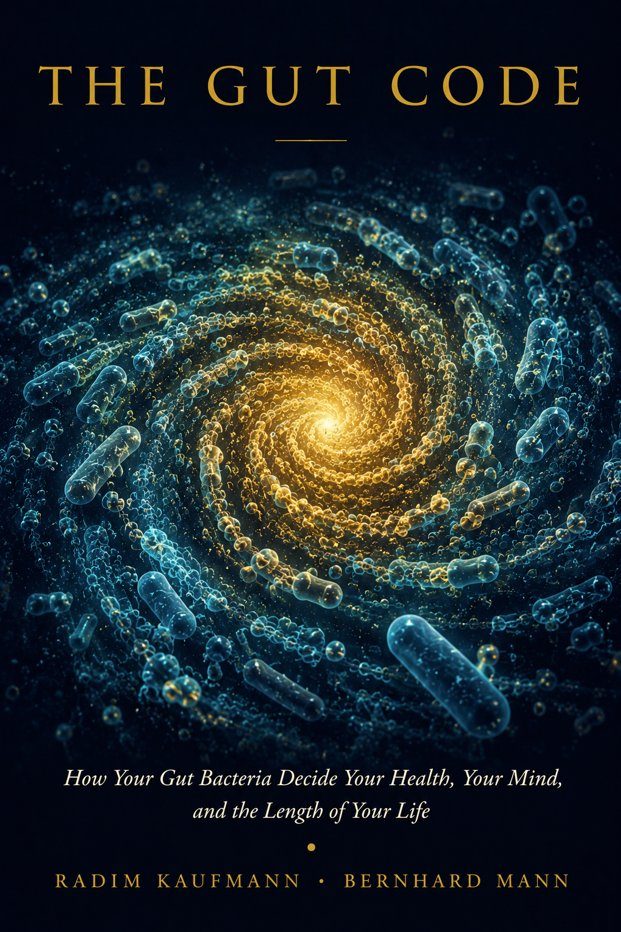
How Your Gut Bacteria Decide Your Health, Your Mind, and the Length of Your Life
A practical synthesis of microbiome research — written for the curious reader, not the specialist. We trace the threads connecting gut bacteria, inflammation, fiber, sleep, and longevity through the latest peer-reviewed science, then translate the findings into clear, evidence-based principles you can actually use. No supplement hype. No pseudoscience. Just the signal beneath the noise.
The book maps an ecosystem; these are the paths through it. Each will grow into a library of articles, glossary entries, and references as the companion content expands.
The invisible organisms living inside the human body — and why modern medicine increasingly treats them as a vital ecosystem rather than a colony of intruders.
ExploreHow microbiome diversity, inflammation, metabolism, movement, sleep, and diet influence healthspan and biological aging across the human lifespan.
ExploreThe silent biological fire behind many modern chronic diseases — and the emerging role gut bacteria play in immune balance and chronic low-grade inflammation.
ExploreHow sleep, stress, cortisol, and the gut–brain axis interact with the microbiome — and why the night hours may matter as much as what is on the plate.
ExploreClear, plain-language explanations of key microbiome terms, bacteria, metabolites, and medical concepts — for readers who want to follow the research without the jargon.
ExploreWhat long-lived populations may teach us about food, fiber, movement, social connection, and microbial resilience — and what the research actually supports beyond the headlines.
ExploreWhy dietary fiber feeds gut bacteria, supports short-chain fatty acid production, and influences metabolism, satiety, and inflammation in ways popular nutrition still oversimplifies.
ExploreEach article is drawn from a chapter of The Gut Code and written for readers who want the science without the noise. Articles are being published as the companion series expands.
The trillions of organisms inside you — what they are, where they live, how they got there, and why the term "microbiome" replaced "gut flora" in the scientific literature.
In PreparationFrom centenarian cohorts to mouse studies on caloric restriction — the threads connecting microbial diversity to the biological markers of healthy aging.
In PreparationAcute inflammation heals. Chronic inflammation corrodes. The line between them runs through the gut wall — and the bacteria on the other side of it.
In PreparationWhy "I have a gut feeling" turns out to be more literal than language intended — and what the vagus nerve, the enteric nervous system, and serotonin have to do with it.
In PreparationInsoluble, soluble, fermentable, resistant — a brief tour through what "fiber" actually means at the bacterial level, and why butyrate matters more than most people know.
In PreparationSardinia, Okinawa, Loma Linda, Nicoya, Ikaria — what these long-lived populations share, and which lessons survive the translation from anthropology to clinical evidence.
In PreparationThe microbes follow a clock too. New research suggests the gut–brain axis runs on a 24-hour rhythm — and that even one bad night may register at the bacterial level.
In PreparationWhen gut bacteria ferment fiber, they produce short-chain fatty acids — signaling molecules that influence the immune system, the gut wall, and metabolic regulation throughout the body.
In PreparationThe clinical term for a disrupted microbiome — what causes it, how it is assessed, and what the growing body of evidence links it to across metabolic, immune, and neurological conditions.
In Preparation