The World into Which the Buddha Was Born
1.1 The Ganges Plain and the Rise of Cities
Imagine a road beginning at the edge of a village. Between houses of timber and packed earth, a narrow path opens onto fields. Farther on, wagon wheels have pressed it into a wider track. There is no city on the horizon, yet the village is no longer a world unto itself. Merchants, pilgrims, storytellers, and people who have left their households behind may all pass this way. One traveler brings news of grain prices. Another claims to know a path beyond the seemingly endless cycle of birth and death. We cannot reconstruct the details of any particular morning. This is a literary scene, not an eyewitness account. But it brings into view the changing society in which the early Buddhist movement took shape.
Across northern South Asia, especially in the broad basin of the Ganges and its tributaries, patterns of settlement and exchange changed over the first millennium BCE. Farming communities became linked to markets and larger settlements. Some people specialized in crafts, and new urban centers emerged in a process historians often call South Asia’s second urbanization. The first great urban civilization of the subcontinent had belonged to the much earlier Harappan world. Now cities developed in different places, on different foundations, and over a period that varied substantially from region to region.1
No single invention or ruler brought this transformation about. Agricultural production, the movement of people, trade, political organization, and the changing use of materials all mattered. Iron tools contributed to economic life in some areas, but the story is not as simple as iron arriving and cities suddenly appearing. Archaeology reveals uneven patterns of settlement growth. Literary sources portray a world familiar with ambitious rulers, commercial journeys, gifts, loans, and struggles for status. Those kinds of evidence illuminate each other without describing exactly the same things.2
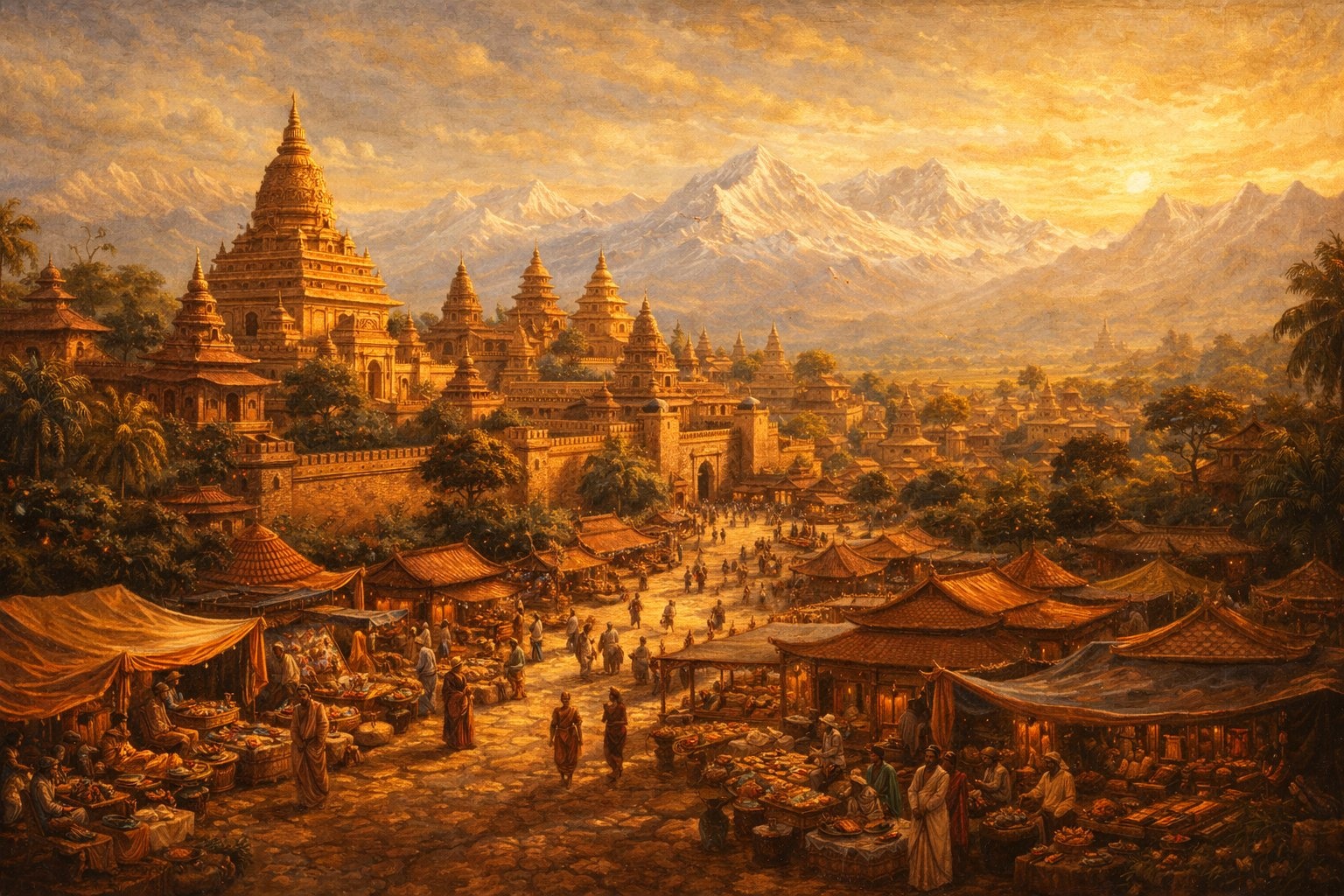
Political life was equally varied. Some large territories were ruled by monarchs and their courts. Elsewhere, authority rested with influential families or clan assemblies. Ancient texts use several names for these political communities; modern histories often group the larger ones under the term mahājanapadas. Magadha and Kosala were among the major powers, alongside Vatsa and Avanti. Each competed for resources, territory, and influence. There was no single Indian state uniting them. Instead, there was a shifting landscape of neighbors, rivals, alliances, and competing institutions.
Near the southern foothills of the Himalayas lived the Shakyas, the community with which Buddhist tradition associates Siddhartha Gautama. In the familiar life story, Gautama’s father, Suddhodana, is a king, and Kapilavastu is a royal capital. Historical reconstruction is less certain. The Shakyas are often understood as a smaller clan-based polity, governed in ways that may have differed from those of the great monarchies of the Ganges basin. This does not make the traditional story worthless. It means that the words king, prince, and palace must be read with care. Later storytellers may have imagined Gautama’s family through the grandeur they believed fitting for the Buddha.3
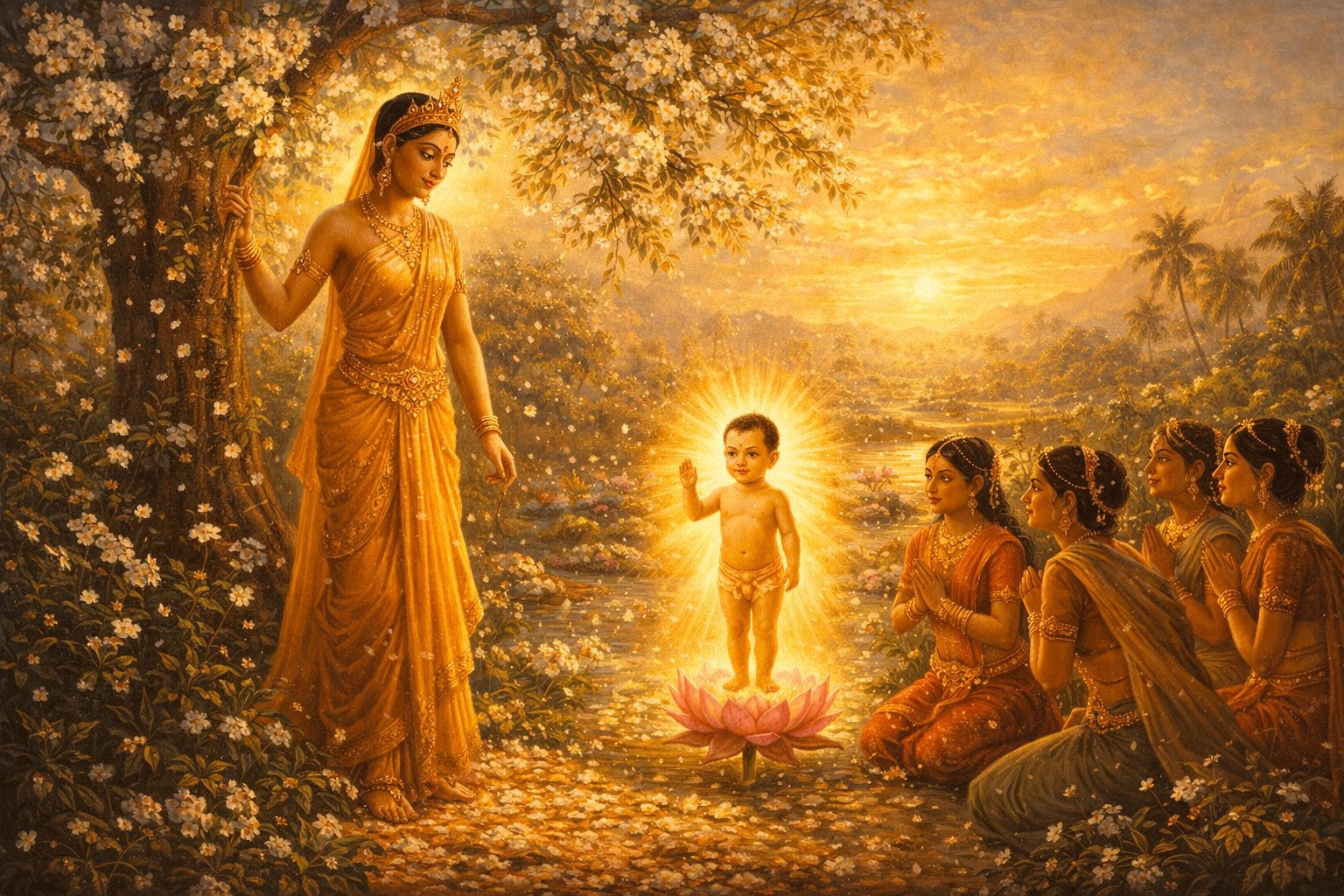
The Shakya homeland belongs to the borderlands of what are now southern Nepal and northern India. Lumbini, traditionally identified as the Buddha’s birthplace, lies in present-day Nepal. A pillar associated with Emperor Ashoka bears an inscription indicating that, by the third century BCE, the site was honored as the place of the Buddha’s birth. That is important historical evidence for an early pilgrimage tradition. It is not a record written at the moment of the birth, and it cannot verify every miraculous detail in later biographies. The distance between the event and the surviving inscription matters.4
New towns also changed what people could do with their lives. Households that produced more than they consumed might exchange the surplus. Skilled craftspeople could make a living beyond the family farm. Merchants crossed local boundaries, encountered unfamiliar customs, and carried ideas along with goods. Larger settlements brought wealth and political power together, but they made poverty, sickness, aging, and death visible as well. In and around these communities, some people began to challenge ordinary assumptions about what a successful life was for.
That tension is essential to the story ahead. The world in which Buddhism developed was not simply a peaceful landscape populated by contemplative sages. It was marked by political competition, property, labor, inequality, and a vigorous religious imagination. The questions later associated with Buddhist teaching arose within that world, not outside it. What does a human being truly control? What can wealth or authority provide? Why does even a fortunate life end in loss? And if existence is uncertain, is there a way to understand that uncertainty rather than merely hide from it?
Before Gautama enters the narrative as an individual, one point deserves emphasis: he did not arrive in a society that had never asked these questions. Across the Ganges plain, different teachers and traditions were already offering competing answers. Some looked to inherited ritual, others to renunciation, insight, or demanding forms of self-discipline. Those voices are where our next section begins.
The world in which a new teaching emergedAppendix: Notes to Section 1.1
1. Second urbanization. Reshma Sawant, “The Development of Early Historic Urbanism in South Asia,” Oxford Research Encyclopedia of Anthropology (2023), DOI: 10.1093/acrefore/9780190854584.013.318.
2. Archaeology and written traditions. Lars Fogelin, An Archaeological History of Indian Buddhism (Oxford University Press, 2015), introduction and chapter 3.
3. The Shakyas and politics. Reshma Sawant, cited above; clan-based government is a historical reconstruction, not proof of Suddhodana’s specific powers.
4. Lumbini and Ashoka. UNESCO World Heritage Centre, Lumbini, the Birthplace of the Lord Buddha, https://whc.unesco.org/en/list/666/. Evidence for an early pilgrimage tradition, not an exact birth date.
Publishing team · draft credits
Author / publisher: Radim Kaufmann
Co-authors: Claire Whitaker · Spencer Reed · Julian Hartwell · Tessa Monroe · Gavin Rhodes · Naomi Fletcher · Wesley Porter
Editorial: Erin Caldwell · Camille Foster · Audrey Nolan · Owen Barrett · Marissa Cole · Nora Callahan · Lydia Shaw · Maya Chen · Leah Winters
Research and education: Priya Bennett · Isaac Merritt · Daniel Kim · Cora Delaney · Keisha Benton · Elena Sandoval · Aisha Coleman · Andre Wallace
Art and production: Vera Hollander · Jasper Vaughn · Roman Blake · Celeste Rowan · Hazel Corbin · Fiona Ashby · Meredith Sutton · Devin Cho
Rights and distribution: Tara Mendoza · Jasmine Webb · Camille Stanton · Zoe Langston · Bridget Carson · Denise Walker
Kaufmann Creative AI Studio: Nolan Pierce · Ivy Carver · Lucia Vega · Felix Archer
Individual roles and actual contributions will be verified before publication.